
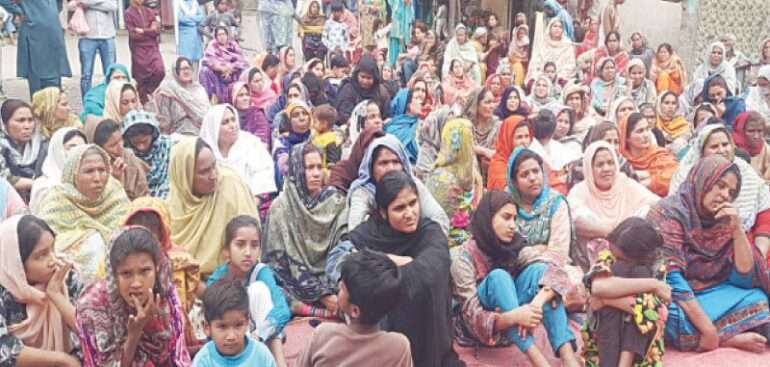
A wave of anguish swept through the narrow streets of Rimsha Colony in Islamabad’s H-9 sector as hundreds of its residents took to the streets, carrying placards and crying out for justice. Their voices trembled with fear and frustration as they protested against the Capital Development Authority (CDA), which has directed them to vacate their homes — or face forced eviction.
For the dwellers of this humble colony, home is not brick and mortar; it is memory, struggle, and survival. “Issuing directives to vacate without offering us any alternative shelters is pure injustice,” said one of the protestors, echoing a sentiment shared by every anxious heart present that day.
The irony cuts deep. Rimsha Colony was not born out of defiance but out of tragedy and state action. Fifteen years ago, after the false blasphemy case against 14-year-old Rimsha Masih shocked the nation, the CDA itself relocated families—mostly Christians—to this very site for safety. Many of these families fled violence and persecution, bringing little more than their faith and hope. They built modest homes here, raised children, and wove their lives around the rhythm of the city — as domestic workers, janitors, and daily wage earners. Now, the government that once sheltered them demands that they move again.
Minorities leader William Pervaiz, addressing the protest, pleaded for compassion. “We are settled here. Where will we go? Our women work in homes, our men in city jobs. If the CDA must vacate the land, give us another place first. We are not asking for charity — only for dignity,” he said. Christian leader and veteran rights activist J. Salik joined the protesters, vowing to defend their right to shelter and safety.
The Human Rights Commission of Pakistan (HRCP) has sounded the alarm, calling the planned evictions “both unjust and unlawful.” In a statement on X, the HRCP reminded authorities that these neighbourhoods — Rimsha and the adjoining Akram Gill Colony — house around 25,000 people, mostly Christians, who were placed there by the CDA itself in the early 2010s. “Eviction notices, despite a 2015 Supreme Court stay order protecting katchi abadis, violate both national law and international human rights obligations,” the HRCP declared, urging the prime minister and other key ministers to intervene before a humanitarian crisis unfolds.
The HRCP further drew attention to the grim pattern of forced evictions now visible across Islamabad. In recent weeks, CDA bulldozers have reduced decades-old homes in Muslim Colony and Bari Imam to rubble. Now, Rimsha Colony faces the same fate. “The cruel irony,” HRCP stated, “is that the CDA itself settled these families here after the Rimsha case. Today, it calls their homes illegal.”
Residents say their existence is no secret to the state. NADRA and the Election Commission of Pakistan both recognise Rimsha Colony as a permanent settlement, while public utilities — electricity, gas, roads, and parks — confirm years of official acknowledgement. “Our homes were never hidden,” said an elderly woman during the rally. “We built lives here after losing everything once. Are we to lose everything again?”
The CDA, however, insists that its actions target illegal encroachments — particularly commercial setups along greenbelts and nullahs — and denies plans for wholesale demolition. A CDA official noted, “If any formal agreement exists showing CDA resettled them here, it will be honoured. But illegal expansion on state land cannot continue unchecked.”
To the families of Rimsha Colony, these assurances ring hollow. Behind every narrow alley stands a story of endurance — of mothers who scrub city floors, fathers who sweep its streets, and children who dream of schooling instead of survival. For them, eviction is not just displacement — it is erasure.
As dusk fell over the protest site, chants still echoed: “We are citizens, not trespassers.”For now, their plea remains simple and heart-rending — they are not asking for privilege, only a place to belong.