
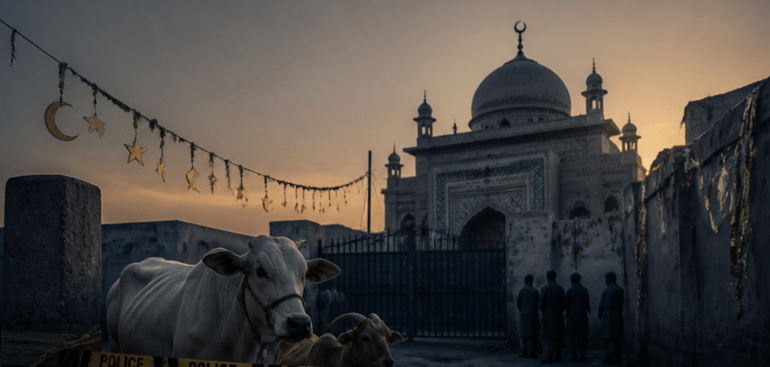
As Eid-ul-Azha approaches, a time meant to embody sacrifice, compassion, and faith, a very different reality is unfolding for Pakistan’s Ahmadiyya community. Instead of preparation and prayer, many are bracing for fear.
Despite Amnesty International raising urgent alarm over escalating violence and discrimination, the threats have not subsided. They have intensified. Reports continue to emerge of sacrificial animals being seized, worship being restricted, and open death threats circulating across social media. Letters are being sent to provincial authorities urging them to clamp down on any visible expression of Ahmadi religious life. For many, even the quiet act of practicing faith has become a risk.
In a recent letter addressed to Punjab Chief Minister Maryam Nawaz, Amnesty International highlighted a troubling surge in harassment and violence, particularly in the lead-up to religious holidays. This pattern is not new. Year after year, documentation shows that hostility toward Ahmadis increases during sacred periods such as Eid and Muharram—moments that should unite communities instead of becoming flashpoints for exclusion and fear.
Earlier this year, during Eid al-Fitr, the situation was already alarming. Across Punjab, local authorities imposed unlawful restrictions on Ahmadi worship. Congregations were explicitly banned in Gujranwala. In Sialkot, police intervened at multiple locations to halt religious gatherings. In Faisalabad, worshippers were removed mid-prayer. In Sargodha, places of worship were sealed. These were not isolated incidents—they were part of a wider, recurring pattern.
Amnesty’s findings point to something deeper than sporadic discrimination. They describe a system where harassment, exclusion, and violence have become structural. A system where rights guaranteed under both Pakistan’s Constitution and international law are repeatedly undermined. The right to worship, to assemble peacefully, to express belief—these are not privileges, yet for Ahmadis, they are treated as such.
The past offers a grim backdrop. In 2024 and 2025, Amnesty documented arbitrary arrests, police harassment, and even forced affidavits compelling Ahmadis to refrain from observing Eid rituals. The United Nations has also raised concerns, noting a consistent rise in intimidation and violence during religious periods. Each year, the same story repeats—only the intensity grows.
This year, the warning signs are even more severe. In recent days, videos have surfaced showing explicit threats against Ahmadis. In one, a man openly declares that those who perform Eid sacrifices will be killed. Such statements are not whispered in secrecy—they are broadcast publicly, amplifying fear.
Disturbingly, pressure is not only coming from extremist groups but also from segments of the legal community. Bar associations in parts of Sindh and Punjab have written to authorities demanding strict enforcement of laws that are often used to target Ahmadis. In places like Karachi, Moro, and Kambar Shahdadkot, coordinated efforts are underway to prevent Ahmadis from offering Eid prayers or performing sacrifices. Even where certain groups are officially banned, their influence persists—sometimes through legal channels, sometimes through intimidation.
Meanwhile, on the ground, the consequences are immediate and deeply personal. Across both Punjab and Sindh, reports indicate that sacrificial animals belonging to Ahmadis are being taken into custody under pressure from hardliners. For families, this is not just interference—it is a denial of religious expression at its most fundamental level.
The persecution does not begin or end with Eid. It is woven into daily life. Graves are desecrated. Funeral rites are disrupted. Professionals face smear campaigns and threats that push them out of public life. Since 2024, even marriage registration has become fraught, with authorities refusing to recognize Ahmadi documentation, leaving families in legal and social limbo.
Punjab remains at the center of this crisis. According to the 2023 census, the vast majority of Pakistan’s Ahmadi population resides there. While the provincial government has taken steps in recent years to promote interfaith harmony, Amnesty warns that these efforts are fragmented and insufficient in the face of escalating threats.
The organization is now calling for urgent, decisive action. It has urged authorities to ensure that law enforcement does not interfere with religious practices, to end arbitrary arrests, and to prevent attacks on homes and places of worship. It has also called for accountability—independent investigations into past abuses and mechanisms to ensure justice for victims.
At its core, this is not only a political or legal issue. It is a human one. It is about whether a community can live without fear, whether faith can be practiced without punishment, and whether the promise of equal rights holds meaning for all citizens.
As Eid draws near, the question becomes harder to ignore: in a time meant for sacrifice, who is being asked to give up the most—and why?