
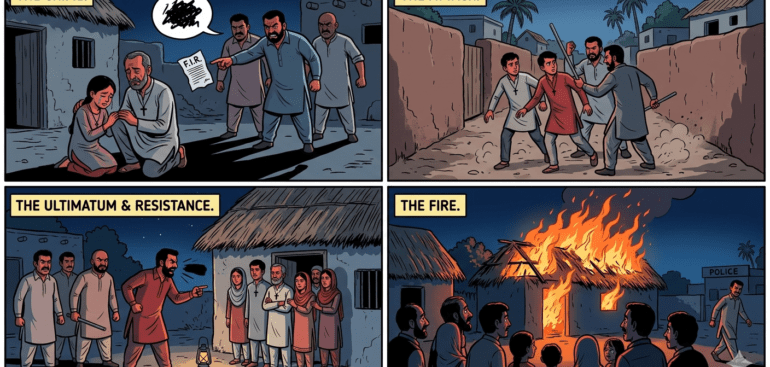
In a small village in Punjab’s Faisalabad Division, fear returned under the cover of darkness.
A Christian family, already carrying the unbearable weight of a brutal crime against their child, now finds itself under siege — not just by memory, but by men determined to silence them.
On April 12, violence struck again.
According to a police complaint, a group led by Zaman Shafique — a man already accused in the gang rape of a 14-year-old Christian girl — allegedly attacked two young men, Faisal Masih and Naveed Masih. Their only “crime” was standing by their family’s decision to seek justice.
The blows they suffered that day were not just physical. They were meant to send a message: withdraw the case, or suffer more.
But the night had not finished speaking.
Around midnight, the attackers returned. This time, they brought fire.
Flames tore through a thatched section of the family’s home, lighting up the village with a terrifying clarity — this was no longer just intimidation, but escalation. A warning written in smoke and ash.
Arshad Masih, who filed the complaint, described a long pattern of pressure. Ever since his uncle, Riaz Masih, reported the rape of his young daughter, the family has been subjected to threats, coercion, and fear meant to break their resolve.
They refused.
And for that, they were punished.
Local church leaders say the threats were not hidden. They were spoken openly, chillingly: if the family did not agree to a settlement, Christian homes would be burned.
“There are only about 30 Christian families here,” said Rev. Khalil Maqsood of St. Mary’s Catholic Church. “They were made to feel small, surrounded, and vulnerable.”
Neighbors rushed in to save the injured young men during the assault, showing that even in fear, humanity persists. But they could not stop what came later — the fire, the destruction, the lingering terror.
Police have registered a case, yet the accused remain at large.
Meanwhile, those standing for justice say they, too have been targeted.
Katherine Sapna, a human rights advocate supporting the family, described repeated attempts to intimidate her organization — phone threats, confrontations, pressure to withdraw.
But she remains resolute.
“We will not yield,” she said.
The fire may have spared lives, but it burned something deeper into the hearts of this family: the reality that seeking justice can come at a cost.
For many minority families in Pakistan, this story is painfully familiar. When crimes occur, the path to justice is rarely straightforward. It is lined with fear, social pressure, and the constant risk of retaliation.
And yet, families like this one continue to stand.
Not because they are fearless — but because silence would cost even more.
Their struggle is no longer just about one case. It is about whether justice can survive in the face of intimidation, and whether the vulnerable can dare to hope for protection under the law.
For now, the ashes of their home remain — a stark reminder of both the violence they endured and the courage it takes to resist it.