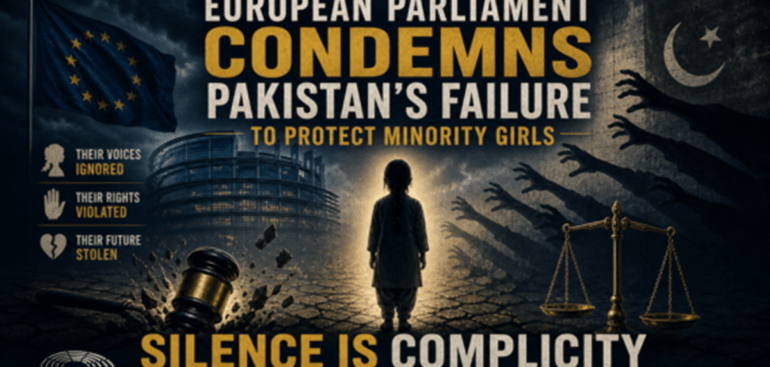
The European Parliament’s condemnation of forced conversions and child marriages in Pakistan deserves recognition. At a time when many choose silence, this resolution sends a clear message: the suffering of vulnerable children cannot be ignored. For families like that of 13-year-old Maria Shahbaz, this international attention offers a rare sense of hope and solidarity.
Maria Shahbaz was abducted from her home in Lahore on July 29, 2025. Within days, she was forcibly converted to Islam and married to Shehryar Ahmad, a 30-year-old man. Despite official documents proving she was a minor, courts accepted her alleged “voluntary” statement—recorded under pressure—and validated the marriage. In March 2026, the Federal Constitutional Court ruled against her family, granting custody to Ahmad. Her case remains under review, but she continues to live with her alleged abductor.
What makes this tragedy heavier is that Maria is not alone. Thousands of minority girls in Pakistan—mostly from Christian and Hindu communities—are reportedly abducted each year, forced into conversion, and married off. Many disappear from their families forever. These are not isolated incidents but a pattern, where silence, weak enforcement, and legal loopholes allow such abuses to continue. Each case represents a childhood stolen and a future erased.
The European Parliament’s resolution goes beyond condemnation—it lays out clear demands. It calls on Pakistan to ensure Maria’s immediate protection, provide her with independent legal representation, psychological support, and access to her family. It urges a transparent, impartial review of her case in line with child protection laws. More broadly, it demands that Pakistan investigate all allegations of forced conversion and child marriage, prosecute those responsible, and strengthen judicial capacity to handle such cases free from intimidation. The resolution also calls for full implementation of laws banning child marriage and the creation of a national mechanism to handle complaints from families of abducted or forcibly converted girls.
By highlighting Maria’s case, European lawmakers have effectively underscored a pattern that civil society groups and human rights organizations within Pakistan have been warning about for years.
The absence of clear laws criminalizing forced conversion as a distinct offense only deepens the problem. This legal grey area allows abusers to hide behind technicalities, while victims are left without protection.
The review of Maria Shahbaz’s case now becomes a critical test. It is an opportunity for Pakistan’s judiciary to correct course and restore faith in justice. But real change will require more than one decision—it demands consistent enforcement, legal clarity, and the courage to protect the vulnerable.
Pakistan’s failure to protect its minority communities is not new—it is a long-standing pattern of neglect. While the state routinely speaks of equality and religious freedom, the reality for Christians, Hindus, and other minorities tells a different story. Their voices are silenced, their cases delayed, and their suffering treated as secondary. When courts uphold marriages born out of coercion, when police refuse to file cases, and when laws remain unenforced, the message is clear: some lives matter less. This is not just a legal failure—it is a moral one.
The European Parliament has taken an important step by speaking out. Now, the responsibility lies with Pakistan to act—so that no child has to rely on voices from outside the country to be heard or protected.