
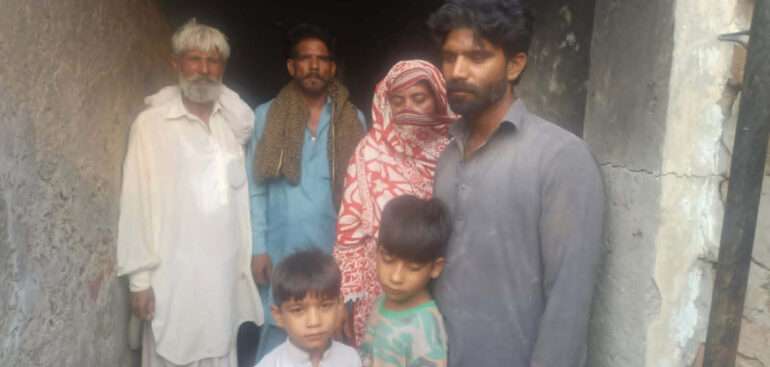
In Pattoki, Punjab, a Christian family has been reduced to homelessness in a deliberate arson attack that raises urgent questions about justice, protection, and equality in Pakistan.
On 5 July 2026, Arshad Masih (34), his wife Kafia Bibi (33), and their two young sons, Haniyal (8) and Abraham (5), were attending Sunday service at the Pakistan Gospel Church when three men — Muhammad Rizwan, Muhammad Iqbal, and Muhammad Aurangzeb (also known as Jani) — allegedly entered their home, poured petrol, and set it on fire.
This was not a random act. It is believed to be retaliation for a dispute just days earlier, when Arshad, a member of the church management committee, questioned Rizwan over the suspected theft of a UPS battery from the church. One of the accused reportedly admitted to the theft and issued open threats. Those threats were carried out with devastating effect.
By the time Arshad returned, his home was gone.
The fire left behind blackened walls, a collapsed roof, and the remains of a life built through years of hard work. Furniture, food supplies, savings, and even the children’s school materials were destroyed. For a daily wage fruit seller, the estimated loss of Rs.750,000 is not just financial—it is catastrophic. The family has been forced to split apart, seeking shelter with relatives, their sense of security shattered. Yet what deepens the injustice is what followed.
Despite witness statements and a registered case (FIR No. 757/26), no arrests have been made. The accused remain free on interim bail. For the victims, this is not reassurance—it is a reminder that those responsible still walk freely.
Equally alarming is the absence of emergency response. No fire brigade arrived as the house burned, leaving neighbours to fight the flames with whatever they had. In moments of crisis, the system that is meant to protect failed to appear.
This is more than an isolated incident. It reflects a wider and deeply troubling pattern—where vulnerable communities face violence, threats turn into action, and accountability remains uncertain.
When a man can lose his home for questioning a theft, and justice moves this slowly, it sends a chilling message: silence is safer than truth.