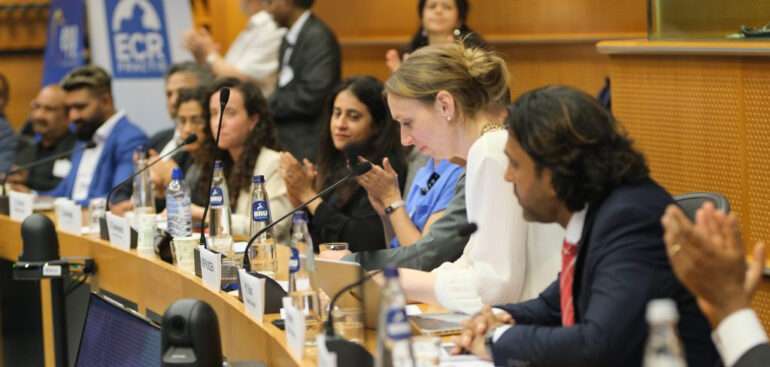
The European Parliament recently held an important event to highlight a painful and often ignored issue: the abduction, forced conversion, and child marriage of minority girls in Pakistan. What should have been a routine policy meeting turned into an emotional call for justice. Victims’ families shared their stories, and for the first time, many in the room saw the real faces behind the headlines.
At the heart of the issue is the story of Maria Shahbaz, a 12-year-old Christian girl from Lahore. In July 2025, Maria was reportedly taken from her home, forced to convert to another religion, and married off. Her case shocked many and led to a resolution by the European Parliament demanding her safe return and stronger protection for girls like her. But as speakers at the event made clear, Maria is just one of many.
A new report released during the event, titled Stolen Girls, documents 210 cases of Christian girls who were abducted, forcibly converted, and married off between 2019 and 2026. The report was prepared by Jubilee Campaign Netherlands and Voice for Justice. It reveals a disturbing pattern: 83% of the victims were under 18, and nearly 90% of the cases were in Punjab. These are not random events. They point to a larger, organized problem.
One of the most troubling findings is how often the legal system fails these girls. Human rights lawyer Sulema Jahangir explained that many laws exist to protect children, but they are often ignored. In some cases, judges have used religious reasoning to allow the marriage of girls who have reached puberty, even if they are under 16. This creates a dangerous gap between the law and how it is applied.
The report also shows how documents are often changed to make these marriages look legal. In 92% of cases, the girls’ ages were falsified on marriage certificates. In 96% of cases, their Christian names were changed after they were forced to convert. These changes make it harder for families to find their daughters and seek justice.
Another serious issue is how girls are treated in court. Many are asked to give statements while still under the control of their abductors. These statements are then used as evidence, even though they cannot be considered free or voluntary. As a result, courts often give custody to the abductors instead of reuniting the girls with their families.
The European Union is also involved in this issue through its trade agreement with Pakistan, known as GSP+. This deal gives Pakistan preferential trade benefits, but only if it follows certain human rights rules. Speakers at the event urged the EU to use this agreement to pressure Pakistan into better protecting its minorities. Some called for the suspension of GSP+ if serious violations continue.
The emotional peak of the event came when a video was shown of victims’ families. Parents spoke about their missing daughters, their sleepless nights, and their hopes for justice. Many in the room were visibly moved. The message was clear: these are not just policy issues—they are human tragedies.
Anna Townsend, author of Our Sisters, shared testimonies from girls who had been forced into marriage. She described how these girls lost their childhoods and were cut off from their families. Her words reminded everyone that behind each case is a real person with a stolen future.
Experts at the event offered practical solutions. They suggested that Pakistan make better use of its National Database and Registration Authority (NADRA) to verify the ages of girls before marriage. They also called for better training for judges and stricter punishment for those who forge documents or take part in forced conversions.
The European Parliament’s resolution on Maria Shahbaz’s case was welcomed by many. Joseph Janssen of Jubilee Campaign said it sends a strong message that the world is watching. But he also warned that resolutions alone are not enough. Real change requires action—both from Pakistan and from the international community.
As the EU prepares to update its GSP system in 2027, there is a chance to make the rules stronger. The new system could allow faster action in cases of serious human rights violations. This could be a turning point—if there is the will to use it.
The girls featured in the report do not need pity. They need protection. They need justice. And they need the chance to return to their families. Until that happens, the promises made in places like the European Parliament will remain empty words.