
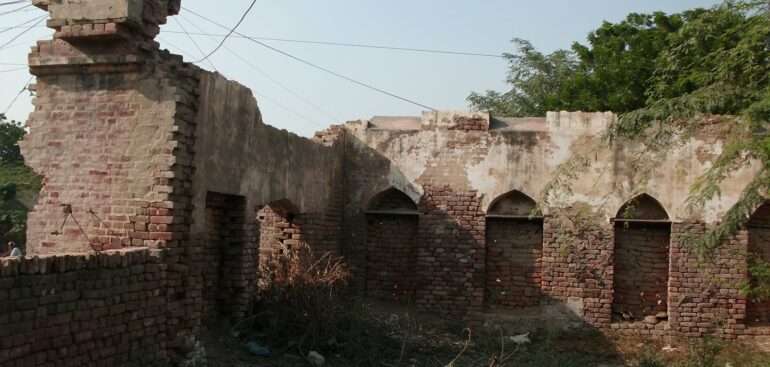
Pakistan loves to speak of its pluralistic past — the land where Hindu temples, Sikh gurdwaras, Sufi shrines and ancient civilizations once stood side by side. Yet behind this rhetoric lies a heartbreaking truth: out of 1,285 Hindu worship sites and 532 gurdwaras recorded on paper, only 37 remain functional today. This is not the result of time or circumstance. This is the result of deliberate state neglect, institutional apathy and a decades-long refusal to honour the religious heritage of the very communities Pakistan claims to protect.
During the first meeting of the Parliamentary Committee on Minority Caucus, this painful reality was laid bare. Senator Danesh Kumar opened the session with a promise that constitutional guarantees for minorities must finally be translated into action. But even as he spoke, members around the table understood the scale of the damage. The fact that 98 percent of Hindu and Sikh places of worship in Pakistan are either abandoned, locked, illegally occupied or left to rot is not an administrative oversight — it is an indictment of the Pakistani state itself.
Dr Ramesh Kumar Vankwani, long a voice for Hindu rights in Pakistan, criticized the Evacuee Trust Property Board (ETPB) with rare bluntness. The Board, which exists to protect minority properties left behind in 1947, has instead presided over their slow-motion destruction. Temples have been encroached upon, gurdwaras have collapsed from neglect, idols have disappeared, and historical structures have decayed beyond recognition while the very institution responsible watched silently. For many Pakistanis, the ETPB is just another bureaucratic department. For minorities, it has become a symbol of abandonment.
The state often argues that these sites are no longer active because the Hindu and Sikh communities in those regions left during Partition. But as MNA Kesoo Mal Kheal Das reminded reporters, this is no excuse. Even if communities migrated, the state still bears the responsibility to protect these structures as heritage sites and as spaces for worshippers who still visit from other parts of Pakistan. Nations that value their history preserve it. Nations that value their minorities protect their sacred spaces. Pakistan, sadly, has failed on both counts.
What makes this neglect more painful is the pattern of systemic discrimination surrounding it. While temples crumble, school curricula continue to carry hateful or discriminatory content. Minority students receive fewer opportunities, with no equivalent scholarship or quota benefits to those offered to Muslim students. Government job representation remains dismally low, and even senior officials frequently skip caucus meetings where minority issues are meant to be addressed. The message this sends is unmistakable: minorities are seen as an afterthought, and their concerns are seen as optional.
The caucus attempted to correct this by recommending that the ETPB chairman should be a non-Muslim — a request so basic that it exposes the deep-rooted structural imbalance. How can an institution in charge of Hindu and Sikh properties not include mandatory representation from those very communities? This is not inclusion; it is common sense. Yet even this modest reform is treated as a bold demand instead of a long-overdue necessity.
There is a tragic irony in Pakistan proudly showcasing sites like Kartarpur to the world while hundreds of other temples and gurdwaras across the country lie in ruins. A single well-maintained shrine cannot erase the silence of the hundreds that have fallen into decay. Sacred spaces where generations once prayed now stand shattered, overtaken by weeds or illegally occupied by private interests. It is a loss not just for minorities but for Pakistan’s identity, its cultural continuity, and its moral credibility.
A nation is ultimately measured by how it treats its smallest, most vulnerable communities. Today, Pakistan stands before the world with a harsh statistic: only 37 out of 1,817 Hindu and Sikh worship sites are still functional. The rest are monuments to neglect. These structures are not just buildings — they are the last echoes of a pluralistic past that Pakistan once promised to protect. Each abandoned temple and each crumbling gurdwara is a reminder that the state has failed its own constitutional pledges of equality, justice and religious freedom.
If Pakistan wishes to reclaim even a fraction of the pluralism it claims to celebrate, it must begin with honesty. It must acknowledge the decades of neglect, restore its abandoned heritage, reform its discriminatory institutions, and treat its minorities not as relics of a forgotten past but as citizens deserving dignity in the present. The question now is simple yet profound: will the Pakistani state act before the last remnants of its shared history collapse into dust?