
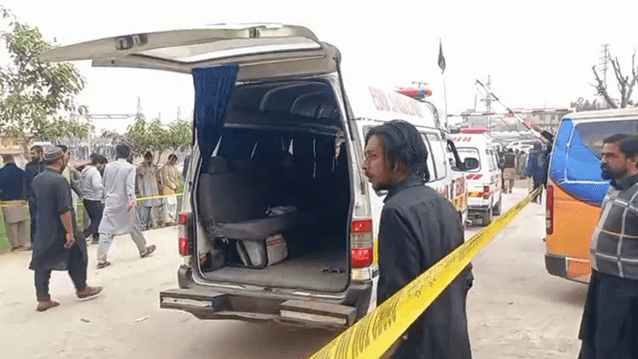
Islamabad — The capital city trembled on Friday as tragedy unfolded once again. At least 15 worshippers were killed and more than 80 others injured when a suicide bomber targeted Imambargah Khadijat-ul-Kubra in Islamabad’s Tarlai area during Friday prayers. For the Shia community, it was yet another assault on faith, safety, and hope.
According to police, the bomber detonated himself after being stopped at the mosque’s entrance. In a matter of seconds, the peaceful hum of prayer became a chorus of screams. Walls blackened with smoke, shoes scattered across the floor, and cries for help pierced the evening air.
At the Pakistan Institute of Medical Sciences (PIMS), 11 bodies and 60 injured were brought in. The hospital quickly reached capacity, forcing emergency staff to transfer victims to Polyclinic Hospital and the Capital Development Authority (CDA) Hospital. Corridors overflowed with grief-stricken families searching for loved ones—many clinging to hope, others to memories.
Islamabad’s Deputy Commissioner, Irfan Nawaz Memon, declared a citywide emergency. But beyond the flashing sirens and official statements, one painful question lingered: how could this happen again, in the heart of the nation’s capital?
This was not just an act of terror—it was an indictment of systemic failure. For years, Pakistan’s minorities, particularly Shia Muslims, have found themselves standing unprotected against hate. Each new promise of security sounds louder than the last, and yet, the cycle never ends.
As rescuers cleared the debris at Imambargah Khadijat-ul-Kubra and families buried their dead, Islamabad once again wore a shroud of mourning. Blood was washed from the courtyard, but not from the nation’s conscience. Until accountability replaces neglect, and sincerity replaces rhetoric, Pakistan will continue to mourn its own for tragedies it could have prevented.