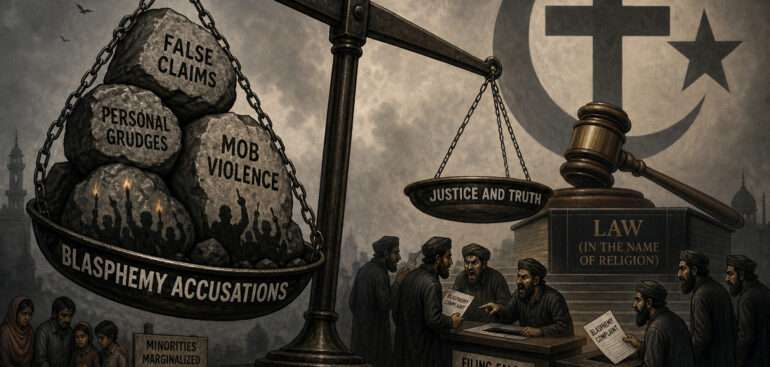
The registration of 333 blasphemy cases across Pakistan in the last five years is not just another statistic—it points to a deeper and more troubling reality. It shows how law, religion, and personal disputes have become dangerously mixed, creating a system that is open to misuse.
Punjab reports the highest number of cases, with 116 registered under Section 295-C. It is followed by Sindh, Khyber Pakhtunkhwa, and Balochistan. But the real concern is not just the numbers. Officials themselves admit that many of these cases are false. A large number are linked to personal grudges, family conflicts, or local rivalries rather than genuine religious offenses.
This raises an important question: how can such a serious law be used so easily for personal gain?
Blasphemy laws in Pakistan carry very severe punishments, including the death penalty. But even before a case reaches court, the damage is often already done. An accusation alone can lead to social isolation, violence, or even mob attacks. In many cases, the accused are targeted without any proof. This makes the misuse of these laws not just a legal problem, but a serious human rights issue.
One commonly held belief is that blasphemy laws are mainly used against religious minorities. While minorities remain highly vulnerable, recent data shows a more complex picture. In Punjab, 56% of cases involve Muslims accusing other Muslims. This suggests that the law is increasingly being used within communities as a tool for settling disputes.
However, this does not reduce the risks faced by minorities. In fact, they remain the most exposed to violence and discrimination once accused. For religious minorities such as Christians, Hindus, and Ahmadis, even a false allegation can have devastating consequences. They often lack the social protection that the majority communities may have, making them more vulnerable to mob violence, forced displacement, and long-term stigma.
There have been multiple instances where minority communities were collectively punished after accusations against a single individual. Homes have been burned, neighborhoods attacked, and entire communities forced to flee. Even when courts later dismiss these cases, the damage cannot be undone.
In Sindh, several cases have been either dismissed or filed against unknown individuals. This highlights weak investigation processes and poor evidence standards. Filing serious charges against unidentified suspects only creates confusion and allows rumors to spread. It also makes it easier for false accusations to gain attention without accountability.
Authorities argue that new procedures, such as immediate registration of First Information Reports (FIRs), have helped reduce mob violence. While this may be partly true, it also creates new risks. Registering cases without proper initial checks can give false accusations a sense of legitimacy. Instead of stopping injustice, it may simply move the problem into the legal system, where the accused still suffer.
Another issue is the lack of expert input during early investigations. Blasphemy is a highly sensitive matter, and without proper understanding, it is easy for misunderstandings to turn into criminal cases. Including qualified religious scholars in the process could help identify false claims early. This would protect innocent people and improve the credibility of the system.
Some of the most disturbing cases come from within families. In one example from Khyber Pakhtunkhwa, children accused their own father during a domestic dispute. This shows how quickly personal emotions can turn into serious criminal charges. When such laws can be triggered by everyday conflicts, it raises serious concerns about their misuse.
The government has acknowledged that the current laws are not perfect. While this is an important step, it is not enough. Real change requires structural reforms. There must be strict penalties for those who make false accusations. Investigations need to be more thorough and evidence-based. Most importantly, there must be protections for the accused until their guilt is proven.
Right now, the system reacts after accusations are made, rather than preventing misuse in the first place. This creates a cycle where false cases are filed, lives are disrupted, and cases are eventually dismissed—without any consequences for those who made the false claims.
Blasphemy laws were originally meant to protect religious beliefs and maintain harmony. But their misuse is now weakening both justice and social stability. When laws are used for personal revenge, they lose their purpose and their moral value.
For minorities, the stakes are even higher. They face not only legal risks but also social and physical danger. Without strong safeguards, they remain at constant risk of being targeted.
Pakistan now faces a difficult but necessary challenge: to ensure that respect for religion does not come at the cost of justice. Without meaningful reform, the number of cases may continue to grow—but trust in the system will continue to decline.